
Front cover — 1 de 2
MISIONES DE CHIQUITOS
VIII FESTIVAL INTERNACIONAL DE MÚSICA RENACENTISTA Y BARROCA AMERICANA
LA TEMPESTAD | SILVIA MÁRQUEZ CHULILLA, harpsichord
APAC 2010 VOL. III | LIVE RECORDING
The former Jesuit missions of Chiquitos in the department of Santa Cruz (1691-1767) and those of Moxos in the department of Beni (1681-1767) are among the greatest treasures of Bolivia's cultural heritage. During the restoration of the Jesuit churches of these missions, a musical wealth of great magnitude came to light: 5,500 sheets of sacred music in Chiquitos and 7,000 in Moxos, written between the seventeenth and eighteenth centuries by European musicians and by the indigenous people of the region alike, and performed daily in these villages until the mid-nineteenth century.
La Tempestad had the opportunity to discover all this richness by taking part, alongside other ensembles, in the seventh and eighth editions of the Festival, in 2008 and 2010.
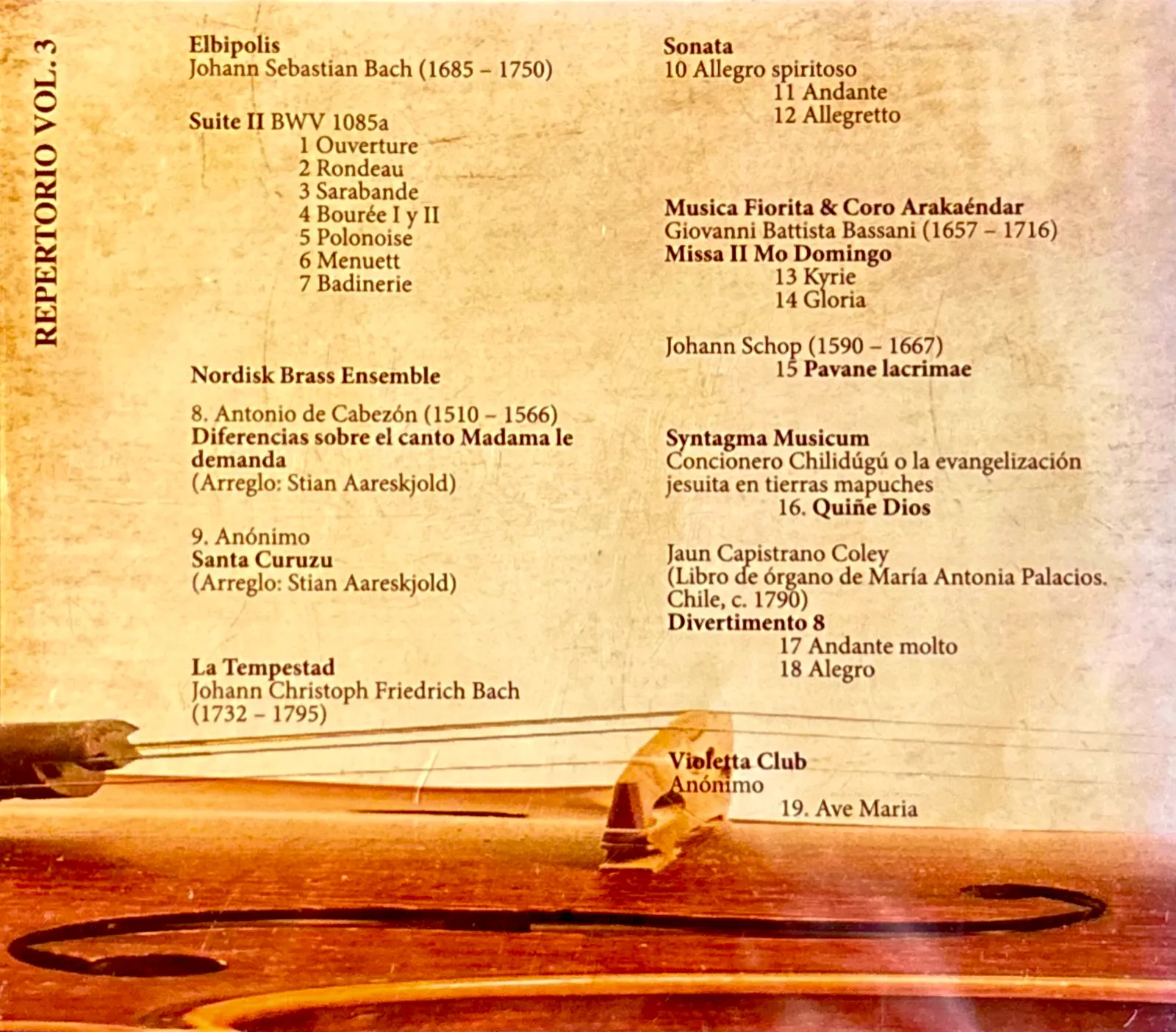
ELBIPOLIS
Johann Sebastian Bach, Suite II en Si menor BWV 1067
01. Overture
02. Rondeau
03. Sarabande
04. Boureé I y II
05. Polonoise
06. Menuett
07. Badinerie
NORDIC BRASS ENSEMBLE
Antonio de Cabezón
08. Diferencias sobre el canto Madama le demanda
Anonymous
09. Santa Curuzu
LA TEMPESTAD
Johan Christoph Friedrich Bach, Sonata en trío en Mi menor HW 7
10. Allegro Spiritoso
11. Andante
12. Allegretto
MUSICA FIORITA & CORO ARAKAENDAR
Giovanni Battista Bassani, Missa II Mo Domingo
13. Kyrie
14. Gloria
Johann Schop
15. Pavane lacrimae
SYNTAGMA MUSICUM
Cancionero Chilidugú o la evangelización jesuita en las tierras mapuche
16. Quiñe Dios
Juan Capistrano Coley, Divertimento 8
17. Andante molto
18. Allegro
VIOLETA CLUB
Anonymous
19. Ave Maria
‘Visitors to the villages of Chiquitos, in Bolivia, find that Beethoven and the taquiraris, or the silhouette of the jaguar and the arpeggios of a zither, can understand one another, coexist and transubstantiate.’
Mario Vargas Llosa | EL PAÍS
The former Jesuit missions of Chiquitos in the department of Santa Cruz (1691-1767) and those of Moxos in the department of Beni (1681-1767) are among the greatest treasures of Bolivia's regional and national cultural heritage. During the restoration of the Jesuit churches of these missions, a musical wealth of great magnitude came to light: 5,500 sheets of sacred music in Chiquitos and 7,000 in Moxos, written between the seventeenth and eighteenth centuries by European musicians and by the indigenous people of the region alike, and performed daily in these villages until the mid-nineteenth century.
To this treasure was added the UNESCO declaration of 1990, which named six villages of Chiquitos as World Heritage Sites and as “living villages”: unlike other former Jesuit settlements of which only ruins remain, in Chiquitos the beautiful churches, the musical scores, the customs, costumes, festivals, ceremonies and instrument-making survive, and in many of them the musical tradition as well. These villages are San Xavier (240 km from Santa Cruz de la Sierra), Concepción (290 km), Santa Ana (520 km), San Rafael (550 km), San Miguel (515 km) and San José de Chiquitos (280 km). There are also other missions which, although not included in the UNESCO declaration, form part of this circuit and are equally extraordinary in their appeal: San Ignacio de Velasco (460 km), Santiago de Chiquitos (420 km) and Santo Corazón (640 km).
The Festival, created in 1996 by the Asociación Pro Arte y Cultura, was originally held in three venues: Santa Cruz de la Sierra, Concepción and San Xavier. Today it reaches other villages (a route of more than three thousand kilometres) that were former Jesuit missions in other regions of the departments of Santa Cruz and Beni, as well as Franciscan and Mercedarian missions in the Santa Cruz territory. This project is unique because it revolves around the living, dynamic cultural heritage of these villages, which keep their traditions alive.
For the musicians it is like stepping back in history, a magical moment because of its historical and cultural resonances. Often the music performed has been arranged or created by the local indigenous people themselves, so cultural identification plays a fundamental role.
Those first missionaries could never have imagined the way in which the Chiquitano peoples would appropriate the instruments and the music they brought from Europe, incorporating them and adapting them to their own culture. So much so that four centuries later one can say that the Chiquitanía (or Chiquitania: the stress falls both ways) is one of the most music-loving regions in the world, where baroque music remains as alive and relevant as in the eighteenth century, nuanced and coloured with local flavour by communities whose idiosyncrasy admirably reconciles the traditional and the modern, the artistic and the practical, Spanish and the indigenous language.
Mario Vargas Llosa (El País, 09/02/2014)
Full article by Mario Vargas Llosa for El País:
Here are the reviews of this album (CD).