
17 January 2021 · News · Press | Media · Reviews
«FIN DE FIESTA»
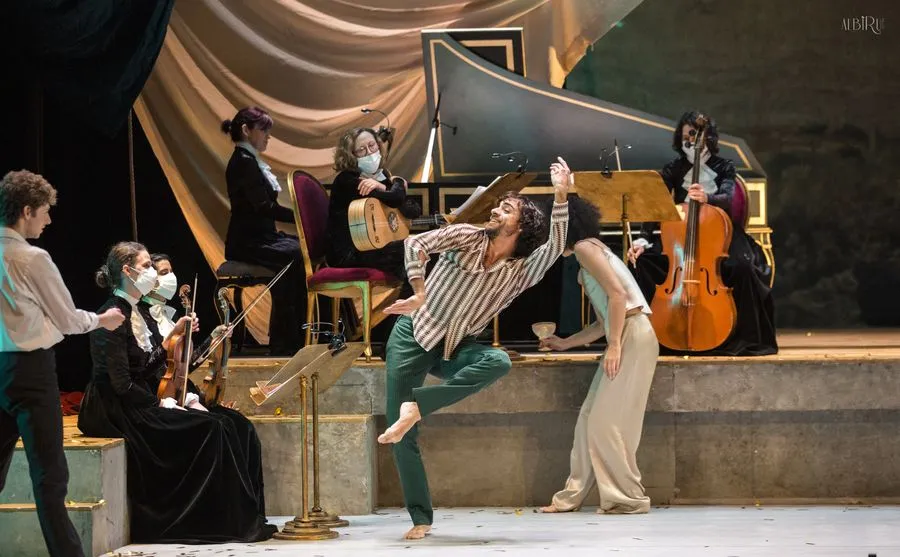
'Fandangos y tonadillas' brings together talents from the CND and the CNTC in a delirious staging that reinvents eighteenth-century Madrid for our own day. This is how we saw it…
What follows is a curious stage production, literally past its bedtime and intentionally grandiloquent, which, without settling on being theatre, choreography or opera, is all of them at once.
Delirious texts, buffoonish recitals, songs with very real reminders of the hardships eighteenth-century artists faced when the theatres closed (the tonadilla Arbitrio para comer, by Pablo Esteve, a brilliant moment of the evening) and that “we'll be back in March if we're still alive” are, without a doubt, winks at our strange present situation, in the midst of the twenty-first century.
REVIEW
SUSY Q | 17/01/2021 | Omar Khan This begins when the party is over. Here the protagonists are the deniers, those impertinent souls who want more and refuse to accept that it is all over. What follows is a curious stage production, literally past its bedtime and intentionally grandiloquent, which, without settling on being theatre, choreography or opera, is all of them at once. Fandangos y tonadillas, which premiered yesterday at the Teatro de La Comedia after the now sadly customary cancellations and changes of date and time [it can be seen until today, Sunday], has as its chief attribute its arbitrariness in mixing and matching genres, periods, styles, costumes, props, manners and customs.The production, in the manner of a baroque comic cabaret, is an alliance of the Compañía Nacional de Teatro Clásico and the Compañía Nacional de Danza, which in turn brought together very diverse talents: Laura Ortega as stage director, Alicia Lázaro as musical director, and Mar Aguiló and Pau Arán for the choreography.
False Italian
Although it uses El italiano fingido, by Ramón Soler, as its narrative thread, what matters more is what is not plot. Delirious texts, buffoonish recitals, songs with very real reminders of the hardships eighteenth-century artists faced when the theatres closed (the tonadilla Arbitrio para comer, by Pablo Esteve, a brilliant moment of the evening) and that “we'll be back in March if we're still alive” are, without a doubt, winks at our strange present situation, in the midst of the twenty-first century.
Sung, acted and danced, the production is an amalgam, not always cohesive, that seems to want to underline the distant first symptoms of the evolution of our contemporary performing arts, tracing them in the music and theatrical customs of eighteenth-century Madrid, in which the entremeses, we now know, were heralds of new forms. Hence the dance, created in partnership by the choreographer and dancer Mar Aguiló and Pau Arán, who was part of Pina Bausch's company, does not attempt (fortunately) to do archaeology or reconstruction, but manages to slot into this feigned baroque context, sprinkled with anachronisms (that eighties disco ball!), as a fully developed expression of our own day, the trio in the Fandango, by Boccherini, being particularly noteworthy. It is a pleasure to see historic CND dancers such as Yoko Taira, Isaac Montllor and Aguiló herself on stage again. The leading role of that magnificent actor and singer with caricature registers, Ángel Ruiz, does not go unnoticed, so delirious and funny is it.
LINKS
Review in SusyQ, Revista de danza: The party's over