



Front cover — 1 de 2
HARPSICHORD CONCERTOS
FALLA, POULENC, BACARISSE
SILVIA MÁRQUEZ CHULILLA, harpsichord | ORQUESTA SINFÓNICA DE LA REGIÓN DE MURCIA. VIRGINIA MARTÍNEZ, conductor | CASTIBLANQUE, SILLA, ESTELLÉS, ITURRIAGAGOITIA, APELLÁNIZ
IBS CLASSICAL IBS82021 | DL GR 419-2021
Besides the recovery and world premiere recording of Salvador Bacarisse's Concerto for harpsichord, this album offers some suggestive interconnections:
The concertos by Falla and Poulenc were both composed for Wanda Landowska (1879-1959), the great Polish harpsichordist who contributed decisively to the rediscovery of much seventeenth- and eighteenth-century music and to the revival of the harpsichord, not only as an early instrument but also as a source of inspiration for twentieth-century musicians. Poulenc's Concert champêtre stands in the immediate lineage of Falla's Concerto. Thus, in the orchestral score of Poulenc's Concert that belonged to Falla, we can read the following autograph dedication by the French composer: “To you, my dear Falla, this little brother of your magnificent Concerto. Fr. Poulenc”.
The three concertos share a neoclassical aesthetic, although from different starting points: in his Concerto, Falla explores and draws on the early sources of Hispanic music; Poulenc evokes the French Baroque; and Bacarisse adopts stylistic elements characteristic of the neoclassicism of the 1920s.
Manuel de Falla (1876-1946)
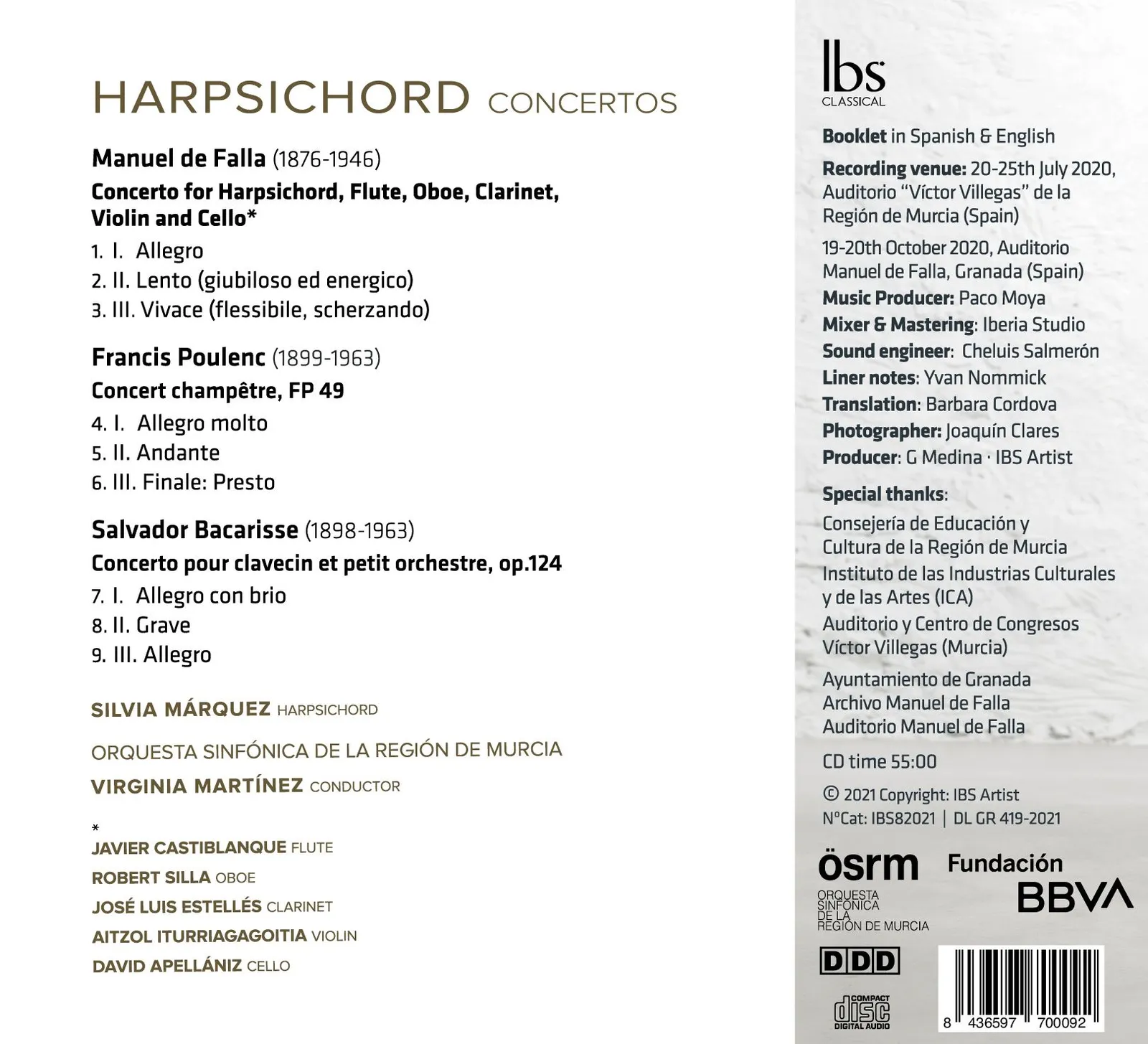
Concerto for Harpsichord, Flute, Oboe, Clarinet, Violin and Cello * 1. I. Allegro 2. II. Lento (giubiloso ed energico) 3. III. Vivace (flessibile, scherzando)
Francis Poulenc (1899-1963)
Concert champêtre, FP 49 4. I. Allegro molto 5. II. Andante 6. III. Finale: Presto
Salvador Bacarisse (1898-1963)
Concerto pour clavecin et petit orchestre, op. 124 * 7. I. Allegro con brio 8. II. Grave 9. III. Allegro
* World Premiere Recording
« In a letter to his friend the painter Richard Chanlaire, dated 10 May 1929, Poulenc reveals: “Into this Concerto I have put my tears, my joys, my very blood, my true flesh”.»
Yvan Nommick
«The Concierto para clave y pequeña orquesta [by Salvador Bacarisse] op. 124 belongs to his last creative period, a stage in which he looks to the late Falla: in 1960 he composed Une aventure de Don Quichotte, an orchestral work inspired by the same episode of the Quijote as Falla's El retablo de maese Pedro, and in 1960-61 the Concierto para clave recorded on this album, whose score has been edited by the harpsichordist Silvia Márquez Chulilla from the autograph manuscript held in the Biblioteca de la Fundación March (Legado Salvador Bacarisse)»
Yvan Nommick
Three glances at the past from modernity
In 1976, in a masterclass given in the Paraninfo de la Universidad de Granada on the centenary of the birth of Manuel de Falla (1876-1946), the composer Rodolfo Halffter declared: “The substantial lesson offered by Falla's last works was the north of the paths we undertook. Each of us followed his own. But the truth is that the different routes led to a single final point of admiring convergence: El retablo de maese Pedro and the Concerto for harpsichord, the two pillars that mark the very high degree of stylistic and spiritual perfection in which Falla's experience culminates”. The reference to Falla's El retablo and Concerto clearly points to his aesthetic mastery over the composers of the Grupo de los Ocho of the Generación musical del 27, to which, in particular, the brothers Ernesto and Rodolfo Halffter and Salvador Bacarisse (1898-1963) belonged. Among the stylistic traits of the members of the Group we may highlight the following: refined technique, formal concision, economy of sonic material and musical means, and a nationalism with a universalist vocation.
As for Francis Poulenc (1899-1963), a French composer contemporary with Bacarisse, although his musical style was influenced chiefly by Debussy, Satie, Ravel and Stravinsky, he deeply loved the music of Falla, with whom he shared a warm friendship and mutual artistic admiration.
This album, besides including three harpsichord concertos composed in the twentieth century, offers some suggestive interconnections:
The concertos by Falla and Poulenc were both composed for Wanda Landowska (1879-1959), the great Polish harpsichordist who contributed decisively to the rediscovery of much seventeenth- and eighteenth-century music and to the revival of the harpsichord, not only as an early instrument but also as a source of inspiration for twentieth-century musicians.
Poulenc's Concert champêtre stands in the immediate lineage of Falla's Concerto. Thus, in the orchestral score of Poulenc's Concert that belonged to Falla, we can read the following autograph dedication by the French composer: “To you, my dear Falla, this little brother of your magnificent Concerto. Fr. Poulenc”.
The three concertos share a neoclassical aesthetic, although from different starting points: in his Concerto, Falla explores and draws on the early sources of Hispanic music; Poulenc evokes the French Baroque; and Bacarisse adopts stylistic elements characteristic of the neoclassicism of the 1920s.
Below, following the chronological order of their composition, we offer details about the history and musical content of the three works.
Composed in Granada between 1923 and 1926, Manuel de Falla's Concerto per Clavicembalo (o pianoforte), Flauto, Oboe, Clarinetto, Violino e Violoncello (the work's original title) has inspired, from its premiere to the present day, the admiration and constant interest of musicians and scholars. Ernesto Halffter bears witness to this, for example: “In Paris […] I attended with Ravel the premiere of the Concerto for harpsichord and five instruments; as we left the old sala Pleyel, the great musician confessed to Adolfo Salazar and me that for him this Concerto was the masterpiece of the century's chamber music, chiefly because of its second movement, which, deeply moved, he called a veritable miracle”.
The Concerto is the last extended composition Falla completed. With this work, composed for Wanda Landowska and dedicated to the eminent performer, Falla, in his own words as recorded in the programme of the premiere, set out to “pay a debt of gratitude to the exquisite harpsichordist for her invaluable instrumental collaboration in the premiere of the Retablo, both in Paris and in New York […]”. The premiere of the Concerto took place on 5 November 1926 in the Palau de la Música Catalana as part of a “Festival Manuel de Falla” organised by the Associació de Música “Da Camera” of Barcelona; the soloist was Wanda Landowska, and Falla himself conducted the instrumental ensemble, made up of players from the Orquestra Pau Casals.
A perfect work, the Concerto is the fruit of a slow creative process, meticulous down to the smallest detail. For three years Falla never ceased writing and rewriting his work, travelling a long and arduous road before reaching the definitive formulation of his ideal. In the correspondence exchanged between Falla and Landowska, we can see how the performer, during her long wait for the Concerto, went through contrasting states of mind: from hope to impatience and exasperation; from feverishness to joy and happiness. Thus Landowska writes to Falla on 28 June 1926: “Yesterday I received a visit from Honegger, who told me he had seen you. He spoke to me about our Concerto. Everyone talks to me about it. The only one who does not know a note of it is me: this exasperates and discourages me”. But three months later, on 21 September, on receiving the score, she expresses her emotion: “Your Concerto is a masterpiece; it makes me vibrate with joy and happiness. I work on it from morning to night, and I think of nothing but finding authentic and exact accents so as to be faithful to you”.
Casting a retrospective glance over Spain's musical past, Falla found in it the elements that allowed him to evoke an eternal, sublimated Spain. The first movement is based on a sixteenth-century Castilian popular song, De los álamos vengo, madre, taken from volume III of Felipe Pedrell's Cancionero musical popular español , who in turn had taken it from the transcription for voice and vihuela included in Miguel de Fuenllana's Libro de música para vihuela intitulado Orphénica Lyra (Seville, 1554), in which he transcribes the polyphonic version by Juan Vásquez (Villancicos y canciones … a tres y a quatro. Osuna, 1551), which Falla also had the chance to consult. In the second movement he uses the Pange lingua (more hispano), a Eucharistic hymn rooted in the history of Spanish music and glossed or used by Hispanic composers from the sixteenth century to the present day (Urreda, Cabezón, Bermudo, Martín y Coll, Eslava, Falla, Gutiérrez Viejo…). The material used in the third movement has a Scarlattian cast and suggests an eighteenth-century world. The asperities of the instrumentation and the audacities of the harmony, together with a broad exploration of Spain's musical heritage and the use of the resources of early polyphony, give the Concerto a unique flavour, at once archaic and profoundly modern.
In the programme of the premiere, Falla himself states precisely his intentions in writing this work: “It is a freely conceived work, although certain traditional values of character and form may be noticed in it, and in its making the laws of tonality have been followed insofar as they are immutable. That is: freedom within discipline, and this inflexible, though only in what represents an essential value, without vain appearances, and with the sole desire of contributing to the social end that Art must always set itself. [...] The music of this Concerto, both in its rhythmic-tonal-melodic character and in its writing, has its origin in general Hispanic music, religious, noble and popular, and the procedures employed by the composer follow, in many cases, others that are long past –and even some very remote– though always subject to present-day manners and possibilities of expression”.
The working manuscripts of the Concerto, edited by the author of these notes (Granada, Archivo Manuel de Falla, 2002), allow us to appreciate the “inflexible discipline” and the self-demand to which the composer subjected himself, perfecting his work without respite, and the variety of sources and references that he investigated, used and combined, materials that span a very broad range of space and time, from Mozarabic music to Schönberg's atonal Pierrot lunaire.
Poulenc composed his Concert champêtre [Concierto campestre] for harpsichord and orchestra, the first of his concertante works, between October 1927 and September 1928. After writing a first version of the piece, he worked intensively with Landowska, to whom he would dedicate it. A few days before the premiere, he recalled in an interview given to Lucien Chevaillier: “We went over [the Concierto] bar by bar, note by note. However, we did not change a single bar or a single melodic line, but the keyboard writing and the choice of the concertante instruments were the object of our deepest investigations. Above all, we clarified the writing, whether by simplifying the chords or by removing notes”. This explains why, as with Falla, Poulenc's creative process was slow and caused Landowska so much anxiety. She wrote to him, for example, on 5 September 1928: “I have just received two thirds of your Finale. I pounced on them greedily, and I realise they are very difficult! Good heavens! Good heavens! What am I going to do? Why are you so late? I think with eagerness and dread of that last third which you announce with two bars, and which has been left hanging on a blank page…”. The premiere was scheduled for 26 October 1928, under the direction of Ernest Ansermet, but Landowska suffered an acute attack of appendicitis that forced it to be postponed. Finally, the Concierto campestre was premiered, with resounding success, on 3 May 1929 in the sala Pleyel in Paris, with Wanda Landowska at the harpsichord and the Orquesta sinfónica de París conducted by Pierre Monteux.
The beautiful woods of the small town of Saint-Leu-la-Forêt, where Wanda Landowska lived, were the evocative landscape that sparked Poulenc's inspiration, as he explains: “I had the idea of composing a country concerto in the style of this Saint-Leu wood in which Rousseau and Diderot had walked, and in which Couperin, like Landowska, had lived”. These references to the French Age of Enlightenment, to its enlightened philosophers and its Baroque musicians, and to the gentleness of the landscape of Saint-Leu-la-Forêt, about 20 kilometres from Paris, are indispensable to understanding this work, but pain, nostalgia, tenderness and jubilation also have their share in it. In a letter to his friend the painter Richard Chanlaire, dated 10 May 1929, Poulenc reveals: “Into this Concierto I have put my tears, my joys, my very blood, my true flesh”.
Like Falla's Concerto, the work is inspired by the model of the late Baroque solo concerto, whose three-movement cycle (fast-slow-fast) it also retains:
An Allegro molto, preceded by an introduction in Adagio tempo that evokes solemn fanfares. Although this Allegro includes a clear recapitulation of the main theme, its construction is very free and unacademic. Poulenc avoids the use of a pre-existing scheme and juxtaposes, in the manner of Stravinsky, independent passages, even inserting a slow section of “tragic” character, in the composer's own words.
An Andante (Siciliana movement) in a pastoral and nostalgic style. In its central part, a harpsichord solo, in the manner of a sombre recitative, introduces a dramatic element into this poetic movement.
A Finale (Presto), launched by a brilliant harpsichord solo, which conveys optimism and happiness and takes up thematic elements from the first movement. In the last bars of the work, the harpsichord evokes, like a distant memory, the slow introduction of the first movement, which reinforces the coherence of the work.
Just as in the last movement of Falla's Concerto there are clear references to some of Domenico Scarlatti's Sonatas for harpsichord, in the Concierto campestre one perceives, above all in the last movement, allusions to Couperin and Scarlatti, but the work is by no means a pastiche. The elements drawn from the past are here profoundly transformed and anchored in modernity.
The compositional style of Salvador Bacarisse, whose catalogue is very extensive, evolves from impressionism –in his first period he considered himself a “spiritual disciple of Debussy”– to neoclassicism, by way of a stage influenced by neo-romanticism. The Concierto para clave y pequeña orquesta op. 124 belongs to his last creative period, a stage in which he looks to the late Falla: in 1960 he composed Une aventure de Don Quichotte, an orchestral work inspired by the same episode of the Quijote as Falla's El retablo de maese Pedro, and in 1960-61 the Concierto para clave recorded on this album, whose score has been edited by the harpsichordist Silvia Márquez Chulilla from the autograph manuscript held in the Biblioteca de la Fundación March (Legado Salvador Bacarisse).
An exile in France since 1939, Bacarisse worked from 1945 until his death in the Spanish section of the Radiodifusión Televisión Francesa, where he produced and presented various music programmes. On 10 August 1960 he devoted a chapter of his programme “A propósito de música” to the “clavecín”, with the collaboration of the French harpsichordist Jeanne Chailley-Bert, who in the 1950s was a member of the Quintette instrumental français. In that programme he spoke of the “rehabilitation” of the harpsichord in the twentieth century, evoking the examples of Frank Martin, Poulenc and Falla. A few months later, on 19 December 1960 precisely, Bacarisse himself began composing his Concierto para clave, which he completed on 18 March 1961. The premiere took place on 25 October 1962 at the Radiodifusión Televisión Francesa, with Jeanne Chailley-Bert, to whom the work is dedicated, playing the harpsichord part.
A fundamentally independent composer, Bacarisse kept away from the techniques and aesthetics that developed in the music of the 1950s and 60s, such as generalised serialism, musique concrète, indeterminacy and electroacoustic music. His Concierto para clave is a good example of this. It is a work that connects with the neoclassicism of the 1920s, but without the humorous and caricature-like elements we observe in some works by Satie, Stravinsky and the Grupo de los Seis. Like the concertos by Falla and Poulenc, it is articulated in three contrasting, well-balanced movements (fast-slow-fast).
The first movement, Allegro con brio, asserts the principal key emphatically from the outset. The orchestra immediately presents the main theme, an elegant melodic line from which the composer will draw various motifs that will germinate throughout the movement. Although the language is clearly tonal, it includes, through the occasional use of the Andalusian mode, a Spanish colour. Likewise, a central section in which, for 24 bars, the harpsichord accompanies the strings using figurations based on the whole-tone scale evokes the Debussyan world. From its first entry, the harpsichord is fully integrated into the orchestral fabric and contributes with its timbre to the creation of beautiful instrumental textures. When it takes centre stage it is not to make a show of gratuitous virtuosity, but to converse with the other instruments or to enrich the overall sonority with its arabesques.
In its three brief minutes, the slow movement, Grave, manages to establish a deep and austere atmosphere, charged with nostalgia. In the harpsichord a beautiful melody in a declamatory style unfolds, accompanied by arpeggiated chords. The modal colour of this movement accentuates the contrast with the two fast movements and evokes, with a certain solemnity, times gone by.
Launched by the vigorous refrain theme, shared between the orchestra and the harpsichord, the last movement, Allegro, is a rondo in which the refrains and the couplets are strongly contrasted in character. The writing of the harpsichord part is brilliant, but as in the first movement, there is no struggle between the solo instrument and the orchestral mass, but balance and close understanding, all the more so as the orchestral textures are transparent. This finale includes a 24-bar cadenza, full in sonority, which leads into the third refrain. It is not a solo intended as a virtuosic display by the performer; based essentially on the main theme of the first movement, it contributes, playing with the listener's memory, to the unity of the work.
Yvan Nommick
Here are the reviews of this album (CD).