



Front cover — 1 de 2

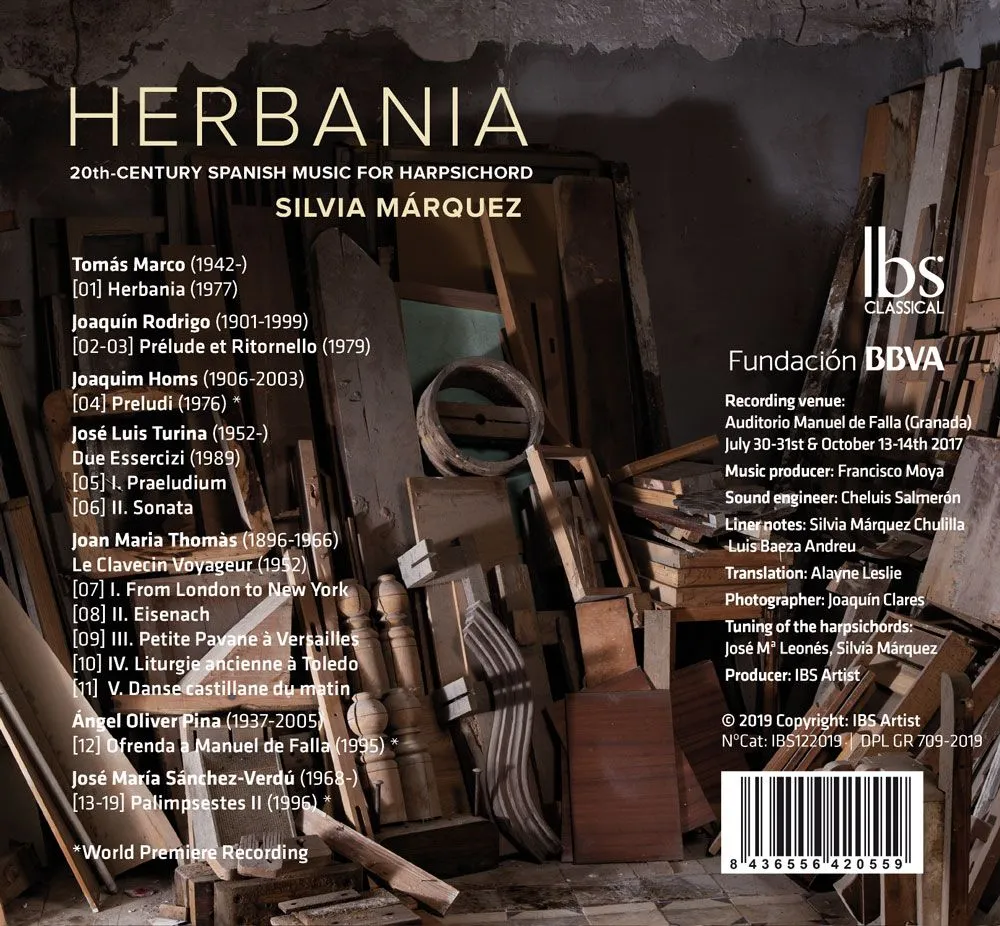
HERBANIA
20TH-CENTURY SPANISH MUSIC FOR HARPSICHORD
SILVIA MÁRQUEZ CHULILLA, harpsichord
IBS CLASSICAL IBS122019 | DL GR 709-2019
Following in the footsteps of her latest, fascinating CD “Chaconnerie” –which includes Roberto Sierra's Montuno, nominated for the Latin Grammy Awards–, the harpsichordist Silvia Márquez Chulilla presents here a surprising bouquet of pieces composed between 1952 and 1996.
Three world premiere recordings –J. Homs, A. Oliver Pina, J. Mª Sánchez-Verdú– and three of the best-known Spanish composers of the day –Tomás Marco, José Luis Turina and the aforementioned Sánchez-Verdú– invite us to step into the piercing, metallic, rhythmic, evocative sound of the second half of the Spanish twentieth century.
Tomás Marco (1942-)
01 Herbania (1977)
Joaquín Rodrigo (1901-1999)
02-03 Prélude et Ritornello (1979)
Joaquim Homs (1906-2003)
04 Preludi (1976) *
José Luis Turina (1952-), Due Essercizi (1989)
05 I. Praeludium
06 II. Sonata
Joan Maria Thomàs (1896-1966), Le Clavecin Voyageur (1952)
07 I. From London to New York
08 II. Eisenach
09 III. Petite Pavane à Versailles
10 IV. Liturgie ancienne à Toledo
11 V. Danse castillane du matin
Ángel Oliver Pina (1937-2005)
12 Ofrenda a Manuel de Falla (1995) *
José María Sánchez-Verdú (1968-)
13-19 Palimpsestes II (1996) *
* World Premiere Recording
“A wonderful album, bringing us Spanish repertoire for harpsichord written in the second half of the twentieth century, with a chronological span running from 1952 to 1996. The protagonist is the excellent Aragonese harpsichordist Silvia Márquez […] Judging by the results of this album, Spanish music has made good use of its legacy, as scant as it is significant. Thanks are due to Silvia Márquez —who also possesses a splendid background as a performer and director of early repertoires with her ensemble, La Tempestad— for selecting this music with such good judgement and playing it so admirably.”
Luis Suñén | SCHERZO
“This is the world, that of music for harpsichord written in the second half of the twentieth century, through which Silvia travels in an album that never ceases to astonish, both for the discoveries it offers and for a sound that dazzles, in the performance as much as in the recorded sound.”
Pablo J. Vayón | DIARIO DE SEVILLA
“An absolutely astonishing album of contemporary Spanish music for harpsichord. WARNING: this is not your father's or your grandfather's harpsichord album.”
Lynn René Bayley | THE ART MUSIC LOUNGE
“I would be remiss if I did not praise Silvia Márquez not only for her technique but for her desire to champion these works and play them with energy and commitment.”
Lynn René Bayley | THE ART MUSIC LOUNGE
“Márquez presents a repertoire that invites us to enter an evocative sound world of the second half of the twentieth century, and to rediscover an instrument that has much to say, above all in the hands of Silvia, a performer with overwhelming technical mastery and an exquisite wealth of nuance. Her talent is spectacular.”
Editor's Recommendation September 2019 | EL COMPOSITOR HABLA
For Annelie de Man, who opened and shared paths.
Everyone must walk at the pace of their own time. Let us allow new beauties to be created and we shall come to like them.
Wanda Landowska
It is impossible to avoid certain autobiographical strokes in introducing this new collection of pieces that are far from usual: sounds recorded in Granada, the city that welcomed Manuel de Falla in 1920 and where, in 1922, he received a visit from the charismatic Wanda Landowska. Thanks to this meeting, Falla became the first twentieth-century composer to turn his gaze to the harpsichord and to introduce it into an orchestral score – El retablo de Maese Pedro (1923)–. His Concerto for harpsichord and five instruments (1923-26), dedicated to Wanda, was the first twentieth-century piece to enter my repertoire, while I was still a student in Zaragoza and barely aware of what that concerto had meant in the History of Music.
My later studies in Amsterdam introduced me, under the guidance of Annelie de Man, to the world of graphic scores, extended techniques, electronics, and working with composers; I discovered the figure of Antoinette Vischer and enjoyed, live, the heartbeat rhythm of Elisabeth Chojnacka's concerts. From the same period dates another episode, set in The Hague, at a gathering devoted to the composer György Ligeti, where I remember with particular delight how a young José María Sánchez-Verdú handed me Palimpsestes II; it was the first time a composer had given me a work for my instrument, dedication included –here it is, more than two decades later, closing the album and recorded for the first time–.
And what had become of harpsichord music in Spain between Falla and Sánchez-Verdú? Through the eyes of a young student the answer was not easy to find, when this repertoire formed no part of formal training nor of the programming of concert halls. Names such as Luis de Pablo or Tomás Marco quickly appeared among those who had written for A. Vischer or E. Chojnacka, but beyond this the picture was not very encouraging.
In one of her notebooks from 1952, Wanda Landowska wrote: “I wonder what modern music can bring me. Will it be a refuge, a diversion, joy, consolation?”. From 1952 dates precisely the oldest piece included on this CD: Le Clavecin Voyageur by Joan Maria Thomàs, an organist and composer who, ahead of his time, had founded in Mallorca in 1926 the “l’Associació Bach per la música antiga i contemporània”. It is perhaps the first piece for harpsichord composed on Spanish soil in the twentieth century after those by Manuel de Falla mentioned above, who was then an intimate friend of the Mallorcan composer.
The first real impulse or spur to creation came with the arrival of the harpsichordist Genoveva Gálvez, first in Santiago de Compostela in 1959 and later, in 1972, in Madrid as the first Professor of Harpsichord in our country. Genoveva burst onto the capital's scene with an open mind, in contact with the composers of the moment. What this conservative Spain offered was a somewhat conventional writing –sometimes as a recreation of atmospheres of the past, sometimes by way of homage– which did not yet go beyond the limits of the instrument nor venture into electronics –in some cases groundbreaking in sonority, the most rebellious examples being the very extremes of the album: Herbania and Palimpsestes–. Even so, the fact that a good number of composers paid attention to the instrument represents a break, a renewal, the gradual return of the harpsichord to the contemporary creative universe. Genoveva would be a key figure; not for nothing are three of the pieces collected here dedicated to her –those by Joaquín Rodrigo, José Luis Turina and my fellow Aragonese, Ángel Oliver–. The Beca Leonardo from the Fundación BBVA, of which I was a recipient in its 2017 edition, has made possible not only this album but also a broad project to promote harpsichord music in twentieth-century Spain. The project includes a documentary that will see the light in the near future. Of the composers on this album, those who are still with us –as well as Genoveva herself– had the kindness to receive us and share a good part of their time, their first contacts with the harpsichord, their memories…
At times we strive to find too much meaning and explanation in works of art. There is no better fortune for today's performer than to have the composer present. Honesty and simplicity flow from the conversations with Tomás Marco, José Luis Turina, José María Sánchez-Verdú; virtues that help us to normalise and promote this repertoire, perhaps also to update its interpretation. They impose no limits; they suggest adapting the music to the instrument and the available registers. There are no grand aspirations or tribulations behind each of the works: a moment, a discovery, an idea… a past, a reference and a timbre –which eventually attracts– to play with. From a respect for the past, the harpsichord reads new pages of recent times.
That is why I did not want a booklet with technical, analytical, convoluted notes –dates and names accompany each of the CD's tracks; a quick search on the Internet yields far more information about any of the composers than is desirable here–. What I wanted was a view from outside, a clean listening, captured with the beauty and restlessness that Luis Baeza's pen distils. With him, I invite you to step into the piercing, metallic, rhythmic, evocative sound of the second half of the Spanish twentieth century.
Silvia Márquez Chulilla
Distance from the beautiful
We call beautiful that which is strange, or perhaps mysterious and inaccessible. Nabokov says that in order to recognise the beautiful, a human being needs to keep, for quite some time, a distance from the object of the dazzlement.
Routine dulls the mind. We quickly grow used to the protocols of gesture and of words, and we no longer name the things of the world with that intense radiance of the first time. And perhaps that is why the fantasy of art exists, obliging us to be amazed and enraptured, to show ourselves feignedly pure before a creation that stands apart from the world yet cannot exist without it. To be always, again and again, something different yet the same. To return, once more, only to move away again.
This is the journey of the harpsichord, a solemn animal that has crossed time and been, at once, its witness and its bearer. Here you have time, pronounces the harpsichord. It brings it to us in the form of ornament or with greater simplicity. It portrays it with contortion or with anguish. From palaces it gathers their gallant atmosphere, and from the islands of the avant-garde a reckless, adventurous wind. Take time, it insists, and at times it reminds us of a golden dress or an ancient dance.
Feminine harpsichord
Its steps soon turned towards an unexplored path, led by several women. Like one who clearly senses a destiny, Wanda Landowska ventured resolutely into that still uncertain forest of the new aesthetics. As a promoter and performer, besides rescuing the harpsichord to play baroque and classical music, she saw in it an ideal expressive medium for the novel contemporary manifestations. The ear would now seek dryness and restraint in expression, far from the romantic and sentimental outbursts of other eras. An animal of measured strength, the harpsichord; a species that, in passing, seduced great composers such as Falla and Poulenc.
After Landowska, other women consolidated this return of the harpsichord to the stage and to contemporary creation. Many twentieth-century composers wrote with enthusiasm for Antoinette Vischer, Annelie de Man, Elisabeth Chojnacka or Goska Isphording. And in Spain, in the 1960s, it was Genoveva Gálvez, the first Professor of Harpsichord, who ensured that this initially solitary crossing drew the creators of the moment to populate that new space of surprising sonorities.
Sketches of atmosphere
Music organises us. It makes us be. We sound beneath the flesh and the arteries. Again and again. Always the same yet different. Pain resounds in the night, and joy is always heard as a drumroll of laughter.
This album has much of primal evocation. It is an invitation to a journey. An approach to some place and a subsequent flight, a movement towards a city or towards a temperature. For one travels not only to harbours and squares. One lands, often, in an atmosphere or in a memory, and it is this music that brings its clearest forms to our understanding.
1. HERBANIA | Tomás Marco (1942-)
The landscape is desert-like and arid. The volcanic earth is exuberant in its nakedness. And the wind, the sand and the rocks shape in this space a peculiar cadence thanks to their misalignments. A wave. Another. We do not produce rhythm: we are its anthology. Anguish appears as a tightening in the throat, eyes covered in sand and thistles. The pulse of the music unmasks us. The first pumping, the first wail of language, the tectonic shift beneath the flesh already under way. To sing is to tremble. We are bodies adrift, the syncopated accent on this island that never ends, the volcano within the volcano within the volcano.
2. 3. PRÉLUDE ET RITORNELLO | Joaquín Rodrigo (1901-1999)
The slowness of a doubt. Its persistence. In the absence of certainties, circumlocutions arise and words are smoke. The music advances, lingering, resolutely irresolvable, back towards its beginning. Timidly, it hides and emerges. The song is a circle, the frustration of a story that cannot find its outlet. And, expectant, imperious, it waits for a ray of light to put an end to that cowardice.
Freed at last from its claustrophobia, the song finds, finally, its course. And what before groped in the dark now unfolds with obsessive firmness towards a conclusion long overdue.
4. PRELUDI | Joaquim Homs (1906-2003)
Reality lies far away: the river, in the river itself; the tear, at the edge of the eye, in some shameful bed; the storm, in its own disaster. The human is a stain. Sounds contemplate themselves in a mirror and recognise themselves as pure, self-sufficient. The universe of twelve spheres moves in constant rotation and all bodies are reflections of themselves or of other bodies. And the world plays at being this accelerated melody through broken, fragmentary images. Music is an intimate and absolute pleasure. It will be in the naked body of poetry, forever stripped of its garments, pure and innocent as Juan Ramón wished, that we shall gather to celebrate the ritual of art.
5. 6. DUE ESSERCIZI | José Luis Turina (1952-)
PRAELUDIUM | The performer unfolds the chords like an uncertainty, in the manner of Louis Couperin's non mesurés preludes. The melody will be an expectation, a desire suspended awaiting its most plausible resolution. Or its most logical continuation. It is a game of wills: the performer groups the notes without measure, like a craftsman shaping matter, and the listener offers himself as a destination where that new being of air will come to die.
SONATA | The shock will come afterwards, with the unstoppable burst of the semiquavers. Lively and insistent, they will give silence no respite. And the music will be perpetual like remorse. Miguel de Unamuno declared his thirst for eternity, the secret and bashful longing of men to exist for ever. Death is perhaps merely an orthographic device that gives meaning. We need endings when all possible combinations have been exhausted. As Borges says, the end will bring, above all, great relief.
7. 8. 9. 10. 11. LE CLAVECIN VOYAGEUR | Joan María Thomás (1896-1966)
I. FROM LONDON TO NEW YORK | In great cities, mire and hope live side by side. The speed of light is no greater than that of bodies. People pile up, frenzied and clumsy, like disoriented pigeons that will never show off their flight. They wander towards uncertain places, but always with the determination of one travelling to a destination. They flee. It is easy to disguise sorrow at the centre of this hyperbole. And euphoria and joy are barely sketched. No one will notice that multiplied body. And the hours will advance, trampling over one another, a procession of machines crossing the spirit of the one who escapes. And the city will be a taste of iron on the lips and an unheard-of temperature in the blood.
II. EISENACH | To return to this city is to give coherence to the tale. The syntax of memories falls into order and the mind understands, at last, its language. The castle will still be there, the fountain and the cobbled road. The painful light of the afternoon will be identical. Once again the illusion of the repeated. There are cities with a complicated orthography, a density of fugue or of gale. The artifice of an ancient music is engraved in you, and as you gaze at the towers, the bridges, the battlement, the same flock of birds as then will refresh in your memory its affected melody.
III. PETITE PAVANE À VERSAILLES | The dolls have developed a surprising aptitude for eternity. In their palace of chandeliers, they dance an orthopaedic dance. The corridors are very long and their smiles even more endless. You peer into the old house with unease. Happiness was a piece of plastic; childhood, this mutilated dance in which time bleeds out in its finest attire.
IV. LITURGIE ANCIENNE À TOLEDO | Travel is always a question. And on this journey you climb the streets in an inquiring spirit. At times, a labyrinth. You arrive in the belly of another century and the harmony sounds like the lance of a languid knight. The air carries the memory of some battle, the deafening bellowing of the animals that went mad in the square, the enigma of the witches who crossed the night with their potions for lovers. A wise king, with his court, translates what is known of the movement of the stars. Verbs and constellations are conjugated, the objects of the senses and those of the soul. All those men look to the heavens, and there they place their trust, clinging to a fabulous language whose bones are already beginning to grow.
V. DANSE CASTILLANE DU MATIN | In the square, children play in the sun. That yawn of light creates, together with the aridity of certain sorrows, a counterpoint. The fountain, at the centre, breathes out a weary breath. There the smallest children crowd with eagerness and the birds rest from their illusion of flight. Time passes face up and, from afar, the stomach of some giant roars. The days follow one another bravely, and the square, the road, the eternal plain, and the joy of the ancient dances that still throb beneath the forgetful skin of some knight-errant remain faithful.
12. OFRENDA A MANUEL DE FALLA | Ángel Oliver Pina (1937-2005)
The flowers will bring us a scent of sex. We shall long for the warmth of that enamoured saliva. And from the depths of the throat, a broken complaint and a mystery will emerge. The morning will unfold its wound and desire will tremble in the water. Music will be the spell, the fuel of this fire. Beneath the flesh there is a violence that will pierce the earth: some cities hurt as much as a gash.
13. 14. 15. 16. 17. 18. 19. PALIMPSESTES | José María Sánchez-Verdú (1968-)
Not even a wave breaks the same way twice. Each new sorrow has its own shape. And enraptured lips will always pronounce the same words of love differently. We shall fall for the same reasons, but the harm will always be unequal.
Art always returns to itself, but never identical, like Heraclitus' river. Music and literature have in truth always begun from other, generative works. And novelty and innovation are, in this sense, only a fantasy.
Like palimpsests, the motifs are superimposed, disguised, modified. And the result will be a pastiche or a parody, an extension or a development, a construction rising upon Antonio de Cabezón's Tiento de primer tono. From there, the new being, a vibrant and ancient specimen, breathes through these seven palimpsests, seven powerful lungs, made of itself again and again, surpassed from its own vigorous and renewed genetics.
Luis Baeza Andreu
Here are the reviews of this album (CD).