



30 April 2021 · Press | Media · Reviews
«CONCEPTO, ACCIÓN Y TRANSMISIÓN» | By José Antonio Cantón
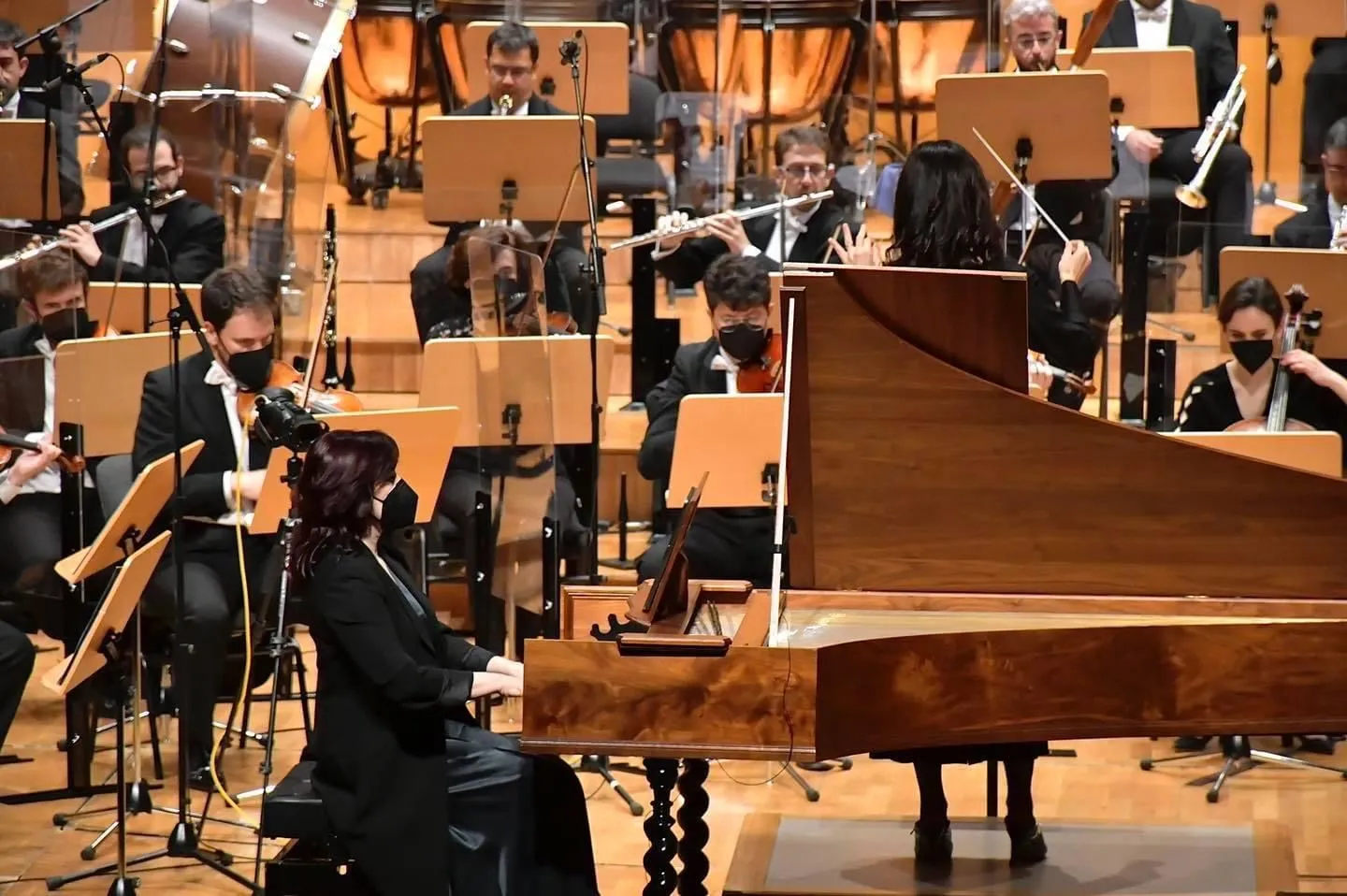
Murcia, 28-IV-2021. Auditorio y Centro de Congresos 'Víctor Villegas'. Orquesta Sinfónica de la Región de Murcia (OSRM). Soloist: Silvia Márquez (harpsichord). Conductor: Virginia Martínez. Works by Poulenc and Stravinski.
Photo: © OSRMDemonstrating a great emotional understanding applied to musical interpretation, the Aragonese harpsichordist Silvia Márquez and the ÖSRM's principal conductor, Virginia Martínez, combined idea, performance and communication in their recreation of Francis Poulenc's Concierto campestre, para clavecín y orquesta, FP 49, with a musicality that involved arduous work to control the particular expressiveness this piece demands, given the difference in dynamic sound between its two concertante elements.
REVIEW
CODALARIO | 30/04/2021 | Jose Antonio CantónDemonstrating a great emotional understanding applied to musical interpretation, the Aragonese harpsichordist Silvia Márquez and the ÖSRM's principal conductor, Virginia Martínez, combined idea, performance and communication in their recreation of Francis Poulenc's Concierto campestre, para clavecín y orquesta, FP 49, with a musicality that involved arduous work to control the particular expressiveness this piece demands, given the difference in dynamic sound between its two concertante elements. With the keyboard instrument equipped with very carefully judged electronic amplification of naturally flat frequency, this handicap was resolved at the outset, although there was a period of adjustment in the balance between the two forces during the opening part of the first movement, after the Adagio that opens it and the soloist's entry with the theme that begins its development. There one could admire her ease and evenness of fingering, as also demonstrated in the cadenza, which might leave the listener wishing to hear this harpsichordist alone, for example in a programme of Flemish or British virginalists.
In the second movement tensions and intensities settled more comfortably, giving one of the happiest moments of the performance, with the feminine sensibility of the two protagonists working very much in its favour to convey the lyricism of its bars, enhanced by an air of siciliana with ambivalent accentuation, which makes this dance, so prized during the baroque, so attractive. Once again, in the substantial concluding coda, Silvia Márquez made plain a musicality sustained by great technical ability.
Her distinctive contribution to the final movement, showing off a fluent dialogue with the orchestra grounded in a great understanding with Virginia Martínez, allowed us to admire the naturalness of both performers, which made it come across as happy music, joined by the woodwind section in its aim of heightening the bucolic character of the music. They thus closed a performance in which the composer's intentions were conveyed in their full aesthetic dimension, reflecting the richness of his neoclassical orientation.
The second half of the concert was devoted to Ígor Stravinski's Primera sinfonía en mi bemol mayor, in which Virginia Martínez, knowing the qualities of the ÖSRM to perfection, got the very most out of each of its instrumental sections. The stamp given to the first movement kept speed and brio at a restrained level so as to help the orchestra settle into the syncopated passages, which are crucial to the fieriness of the second allegro of this opening part of the work, expressed in a kind of constant gallop that demands decisive mastery of the metre of its tempo.
More relaxedly, Virginia Martínez approached the direction of the Scherzo with an orchestral response at its start that was truly eloquent in the woodwind section, creating in the listener a sensation of sonic oscillation until the arrival of the trio, which came to calm the discourse, leaving an impression of calm well understood and even better expressed by the strings before returning to the dynamic of the opening, executed here with greater forcefulness by the percussion.
She accentuated the drama of the third movement, a Largo that allowed the cellos to set out with drama their sonorities, recalling an unmistakably “Tchaikovskian” sensibility, which must have remained in the mind of the young Stravinski. The ÖSRM expressed itself with eloquent feeling, creating different atmospheres within its own sound space, contrasted by solo contributions such as those from the principal bassoon, the horn and the cello, which gave the impression of solid work in rehearsal in pursuit of the drama distilled by this extended movement, without it flagging at any point. The relaxation employed in the Finale favoured a triumphant expressiveness from the ensemble, seasoned by passages in which the woodwind added touches of colour that, through well-sounding harmony, anticipate the mastery of orchestration which this genius of twentieth-century music already showed in his youth. Special mention must go to the brass section, led by a truly striking tuba.
The programme of this concert, in content, length and interpretation, left the audience with a gratifying feeling, perceiving the ÖSRM in fine form, responding to its principal conductor with significant musicality and eloquent sonority in each of its instrumental sections, something that always favoured the communication of the works' message.
LINKS
Review in Codalario: Silvia Márquez and Virginia Martínez with the Orquesta Sinfónica de la Región de Murcia