



19 March 2021 · Press | Media · Presentations and other events
PATRIMONIO NACIONAL PRESENTS ITS 2021 CLASSICAL MUSIC SEASON
For the first time, Patrimonio Nacional has made women as creators and patrons the thematic focus of its Temporada de Música Clásica for 2021. The ensemble La Tempestad, directed by Silvia Márquez, will perform on 24 July with a programme entitled "Sinfonía en femenino".
NEWS
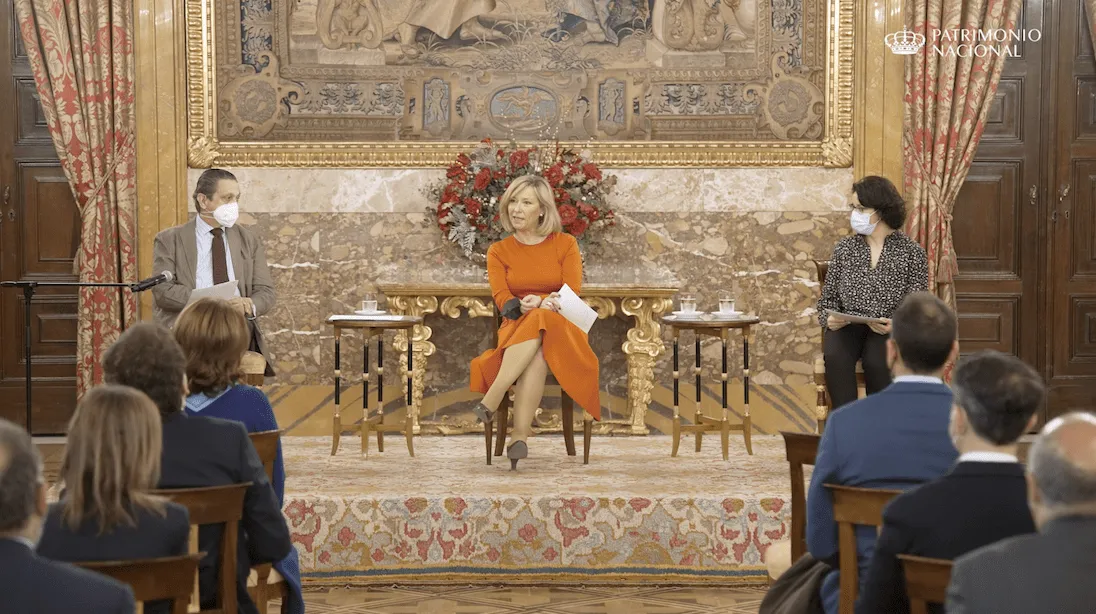
PATRIMONIO NACIONAL WEBSITE | 19/03/2021 Patrimonio Nacional presented its Temporada de Música Clásica for 2021 on Wednesday at an event in which the institution's president, Llanos Castellanos, placed women as creators and patrons at the centre of a programme that will offer more than 45 concerts over the year at eight Reales Sitios under the motto “La mujer en la música de los Reales Sitios, pasado y presente”.For the first time in the institution's history, women will take centre stage in the Temporada de Música Clásica, with 25 premieres of works by composers of the past such as María Rosa Coccia, María Luisa Chevalier and Isabel Prota, among others. Likewise, a historical dance show will be programmed for the first time, the Monasterio de Las Huelgas will be included as a landmark of medieval women's music, and the works of contemporary composers such as Mercedes Zavala and Consuelo Díez will be heard.
This year's season will also turn its attention to research and outreach through the lecture series “Las mujeres en la música de corte”, to be given by researchers and specialists in their respective fields.
“Women in love with music”
The president of Patrimonio Nacional, Llanos Castellanos, stressed that “the great protagonist of this season is women in music, with music and for music. The female role has been rendered invisible by male protagonists who wanted to leave women in the shadows, as mere sources of inspiration”.
In this regard, Castellanos stated that “if in fields such as history, politics and science that opacity is unjust, in music and within these walls it is doubly so, because if music filled these halls, and if Scarlatti or Nebra gathered here, it was because there were women in love with music, who composed, who played, and who had a special sensitivity for spotting talent at the European courts”.
For his part, the Director of Official and Cultural Events, Fernando Fernández-Miranda, highlighted the open nature of series such as “Música de Cámara con los Stradivarius de la Colección Real”, in which most of the scheduled performances “will have an institutional audience and a second performance open to the public, at an affordable price of 15 euros”. “All the other concerts of the season are open and free of charge, without exception”, he explained.
In addition, the season's musical adviser, Judith Ortega, added that “performing works that have not been heard since their premiere, in many cases for centuries, has required extensive prior research and collaboration with teams of researchers, musicologists, art historians, copyists, editors and, of course, the musicians”. “The music of the past makes sense when it is integrated into the present and becomes a point of reference for new generations”, she affirmed.
Always with the aim of offering a safe cultural experience, Patrimonio Nacional will hold the concerts in accordance with the guidelines of the national health authorities and of the governments of the respective autonomous communities. In this regard, it is worth noting that five performances suspended in 2020 because of the COVID-19 pandemic have been rescheduled.
More than 45 concerts at eight Reales Sitios
The 2021 Temporada de Música Clásica of Patrimonio Nacional will be a meeting point between the public and a total of 30 ensembles, choirs and performers in more than 45 concerts, to be held between 18 March and 18 December in eight palaces and monasteries in the autonomous communities of the Comunidad de Madrid, Castilla y León and Extremadura.
Of the seven concert series that make up the season, three are new: “Jóvenes talentos”, which will take place in La Casa de las Flores de La Granja; “Academias y Música de Salón”, which will be held in the Palacios Reales de Madrid, de Aranjuez and de La Granja, and in the Monasterio de El Escorial; and “Música Sacra en las Capillas Reales”, which will take place in the Reales Monasterios de El Escorial, de Tordesillas, de Yuste, de Las Descalzas Reales and de Las Huelgas.
The other four series have a long tradition: “Música de Cámara con los Stradivarius de la Colección Real”, which in its XXXVII edition will bring back several recitals open to the public at a reduced price of 15 euros; ‘Ciclo de Órgano’, featuring the magnificent instrument by J. Bosch, in the Capilla Real del Palacio Real de Madrid; “XXXIII Ciclo Primavera musical en Palacio”, with free public performances by the Unidad de Música de la Guardia Real every Saturday in May at the Puerta del Príncipe of the Palacio Real de Madrid; and “XXXVI Ciclo Música en Navidad”, which will bring the season to a close in the chapels of the Palacios Reales de Madrid and de Aranjuez, and in the basilica of the Real Monasterio de El Escorial.
In 2021 the new season has the main sponsorship of the Fundación Goethe, as well as that of the Fundación Academia Europea e Iberoamericana de Yuste.
In addition, the programme will highlight the close collaboration between various leading institutions in the world of classical and academic music, such as the Orquesta y Coro de RTVE, the Instituto Italiano de Cultura de Madrid and the Instituto Complutense de Ciencias Musicales, as well as with the Embajada de Rumanía and the Instituto Cultural Rumano.
Women open the Temporada in a Comedor de Gala converted into a Salón de Baile
The presentation of the Temporada de Música Clásica featured a performance by La Violondrina, a viola da gamba duo formed by María Saturno and Beatriz Lumbreras, who played the “Sonata en Re Opus XVI nº 12” by the Italian composer and Poor Clare nun Isabella Leonarda (1620-1704), an example of the extremely rare works by women of her time.
The viola da gamba was among the most popular string instruments until the eighteenth century, when it was replaced by the violin family. This type of instrument was not considered suitable for women who devoted themselves to music, since the posture required to play it was perceived as improper for them.
The repertoire performed by La Violondrina during the presentation included some of the most representative dances of the Spanish repertoire, such as “Recercada Primera sobre La Spagna” by Diego Ortiz (1510-1576); “Españoleta de Instrucción de música sobre la guitarra española” by Gaspar Sanz (1640-1710); and “Ay que me río de amor” by Juan Hidalgo (1614-1685).
The performance took place in the Comedor de Gala of the Palacio Real de Madrid, converted for the occasion into a ballroom, as this was another of the functions that characterised this emblematic space until the end of the nineteenth century, during the reign of Alfonso XII.
LINKS
News item on the Patrimonio Nacional website: Patrimonio Nacional places women as creators and patrons at the thematic centre of its Temporada de Música Clásica for 2021 for the first timeLink to the La Tempestad concert: Ciclo Academias y Música de Salón, 24 July, 'Sinfonía en femenino'